Dissolution of the Soviet Union
Voices from ChernobylThe Dissolution of the Soviet Union appears in these accounts as both a political ending and a personal rupture: a country disappears, but the people formed by it remain, unsure what nation can claim them. The testimonies connect that loss to rumor, wartime flight, and the stubborn details of passports, family histories, and possessions carried into an unfamiliar future.
News of an Ending
One speaker describes turning off the radio and living peacefully without following the news. Visitors bring reports of war everywhere and say that socialism has ended and capitalism has begun; alongside these claims comes a rumor that the Tsar is returning. The question of whether this is true captures how the Soviet ending enters ordinary life: as information arriving secondhand, mixed with speculation and difficult to verify. The radio is switched off, yet political change keeps reaching the household through other people.
Two Lost Homelands
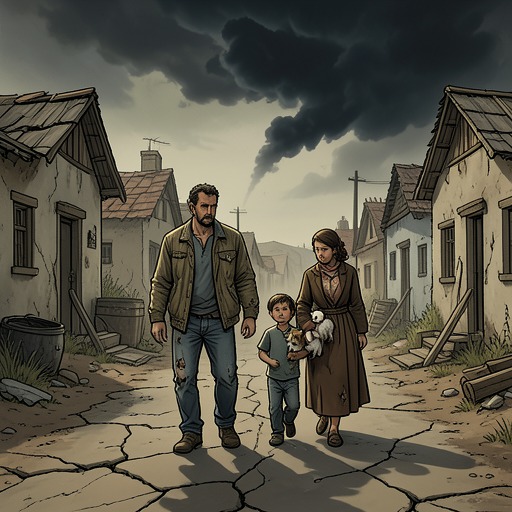
For a family displaced by war in Tajikistan, the Soviet collapse coincides with the loss of a place they can call home. A speaker who has reached Belarus says that Russia does not feel like a homeland because the family was raised differently; the homeland they recognize is the Soviet Union. With that country gone, even the question of how to save oneself becomes uncertain. The new refuge offers a house and work for her husband, and no one is playing with guns, but shelter cannot restore the world left behind.
Another testimony gives the rupture a starkly material form. Fleeing Tajikistan, a family struggles to move its possessions: a two-ton container is made to be unloaded and inspected, while the family sorts through clothes, mattresses, a broken refrigerator, and two bags of books. The speaker understands the flight as the loss of two homelands at once, Tajikistan and the Soviet Union. The collapse is not presented as the cause of every hardship in the journey; rather, political disappearance and wartime displacement converge in the same family’s attempt to leave and begin again.
A Country in the Passport, a Country in Memory
A different speaker traces the break through family ancestry. Her mother is Ukrainian, her father Russian, she was born and raised in Kyrgyzstan, and she married a Tatar. Her children’s passports classify them as Russian, but she rejects that label as an adequate account of who they are: the family understands itself as Soviet, shaped by mixed origins and a shared country that no longer exists. The Soviet Union had been both a political state and the time and place through which these lives made sense of themselves.
The consequences extend across generations. The speaker has five children, from an oldest child in eighth grade to a youngest in kindergarten, and brought them away from the place where she had been born, grown up, and helped build a factory before working there. She describes being told that the place belonged to others and being allowed to take only her children. The loss of the country thus becomes inseparable from the loss of a claim to home, work, and belonging; the family survives, but the national framework that once named it does not.
The Afterlife of the Soviet Identity
These accounts do not reduce the dissolution to a single public announcement or a neat transition from one system to another. They show its uneven arrival: as hearsay in a household that has stopped listening to the radio, as a homeland already absent to refugees, and as a contradiction between official passport nationality and lived identity. For one family, Belarus provides immediate safety and a place to settle; for another, a new home is declared in Chernobyl (town), even as the speaker insists that the former country no longer exists. The recurring distinction is between the survival of people and the disappearance of the political world that had made them feel at home. The Soviet Union ends; the identity it formed remains, unresolved, in those who must carry it elsewhere.